Fiscally & Environmentally Conscious Changes That Work
Surgical centers and hospitals provide life-saving treatment and generate significant revenues for their healthcare systems. At the same time, the surgical suites account for a significant amount of the expenses incurred by the organizations. Medical waste disposal and management significantly contribute to those expenses, with one study estimating that wasted surgical supplies from a single surgical department account for up to $3 million in losses and disposal expenses per year.
Surgery centers are arguably one of the most critical needs of the hospital centers. So, what can be done about the generation of excess waste and the cost of disposal? Administrators should know that just a few small adjustments can significantly reduce losses and the amount of medical waste disposal necessary. This will lead to financial savings and substantial impacts on the environment.
STAY COMPLIANT
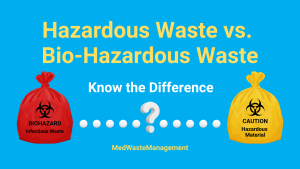
Staying compliant with local, state, and federal medical waste disposal laws prevents the issuance of fines and unnecessary expenses for the organization. Fully understanding each aspect of the law is imperative. For instance, you must use red bags to identify medical waste and ensure it is disposed of properly. The bags must be marked with the biohazard symbol and stored in hard-sided containers.
To assist in your efforts, we provide all the information you need to remain compliant with your medical waste disposal program. If you ever have any questions or need clarification on a regulation, you can call or email us, and we’ll gladly discuss it with you.
REDUCE WASTE
There are several proven ways in which a hospital can save money with its medical and other waste disposal practices. Some include:
Switch from disposable to reusable sharps containers.
The New York City Department of Sanitation estimates that a 1,000-bed hospital that makes this change would save up to $175,000 per year and 34,000 pounds of medical waste.
Use permanent waterproof mattresses when possible.
The Legacy Good Samaritan Hospital in Portland, Oregon, switched out 95% of their disposable mattresses for permanent ones. The initial cost was considerable but recouped in just one year. The savings in purchase costs are now $80,710 per year for this 341-bed facility, and they are contributing 16,350 pounds less of waste to the environment.
Replace disposable diapers with cloth versions.
Kaiser Permanente’s Northwest Region changed from disposable to cloth diapers for newborns, decreasing the amount of solid waste left in local landfills. However, before implementing a change of this magnitude, you need to address concerns related to infection control and infant skin care.
It’s Time to Improve Your Strategy
Surgical centers and hospitals must always carefully manage their medical waste disposal. However, some minor changes can lead to a reduction in the amount of medical waste generated. This is financially beneficial and an environmentally conscious initiative that management should consider regularly.
Start your medical waste disposal improvement strategy by contacting MedWaste Management. Our representatives are available and will happily assist you in developing an efficient plan for handling your medical waste.
We are MedWaste Management – California’s medical waste disposal experts!
Established in 2008, MedWaste Management fills a need for compliant and safe medical waste disposal in the healthcare industry and the general public alike. We publish this blog to spread useful and practical information to help you stay safe, smart, and healthy!
Call us with any questions or to start service at (866) 254-5105. We are always happy to help!
Check out our services and other great resources in the links below.
Medical Waste Disposal Services
Learn How To Properly Manage & Dispose of Household Medical Waste

Tammy McKinney, RN, is a healthcare writer and seasoned registered nurse. With experience in acute care, long-term care, rehabilitation, drug & alcohol, and hospice & palliative care, she combines her medical understanding with her love for writing to educate and inform the public on various health-related topics. You can view a snippet of her portfolio here or contact her directly on LinkedIn!