Sharps containers are one of the most important safety tools in any professional setting that uses sharp items, and are commonly found in medical practices and laboratories. They are designed to hold any sharp object, such as used needles and blades, that could cause injury or spread infection.
Knowing when to replace a sharps container is not just about convenience; it’s about protecting anyone who comes into contact with medical waste. In this article, we go through when sharps containers need to be replaced and some best practices for different medical settings.
The overall rule
In most cases, a sharps container should be replaced when it is around three-quarters full. Though it might seem like you’re wasting space by doing this, there’s actually a very simple safety reason behind it.
Leaving that space at the top makes it possible for waste to be dropped into the container without the need to force items in, avoiding the risk of injury in doing so. Overfilling is one of the most common sharps-related safety risks, and it is completely avoidable if the container is swapped out on time.
Facilities that have areas that generate a lot of sharps waste might decide to replace their sharps containers earlier than this. This is common practice in emergency departments, for example.
The goal is always to prevent a situation from becoming possible in which a used needle or sharp object sticks out of the container opening, or where a staff member has to handle the same sharps waste more than once.
Sometimes it’s better to replace a half-full container, for example, if you know that a lot of sharps waste is about to be generated. This prevents overstuffing later down the line, and prevents injuries from happening during particularly busy times.
Why three-quarters full?
Leaving some space within the container is important as it allows the safety features of the container to work as intended.
For example, sharps containers usually have openings that are designed to make it practically impossible to retrieve a sharp once it has been deposited. If the waste level is too high, however, the lid mechanism may not work properly, putting people at risk of needlestick injuries. This is especially the case when someone is trying to dispose of a sharp in a hurry.
In addition, a container that is too full can cause needles and other items to become lodged in awkward positions, making them more difficult to drop safely inside. This is a risk not only for clinical staff but also for cleaning teams and waste disposal workers.
Signs it is time to replace a sharps container
While the three-quarters rule is a good guideline, there are other signs to look for that indicate a sharps container should be replaced immediately. If the lid does not close properly, the container should be taken out of service.
If it is damaged in any way, such as a crack in the side, it should also be replaced, even if it is not yet full. Any sign that sharps are protruding from the opening is an immediate red flag, and action must be taken to prevent anyone from getting hurt.
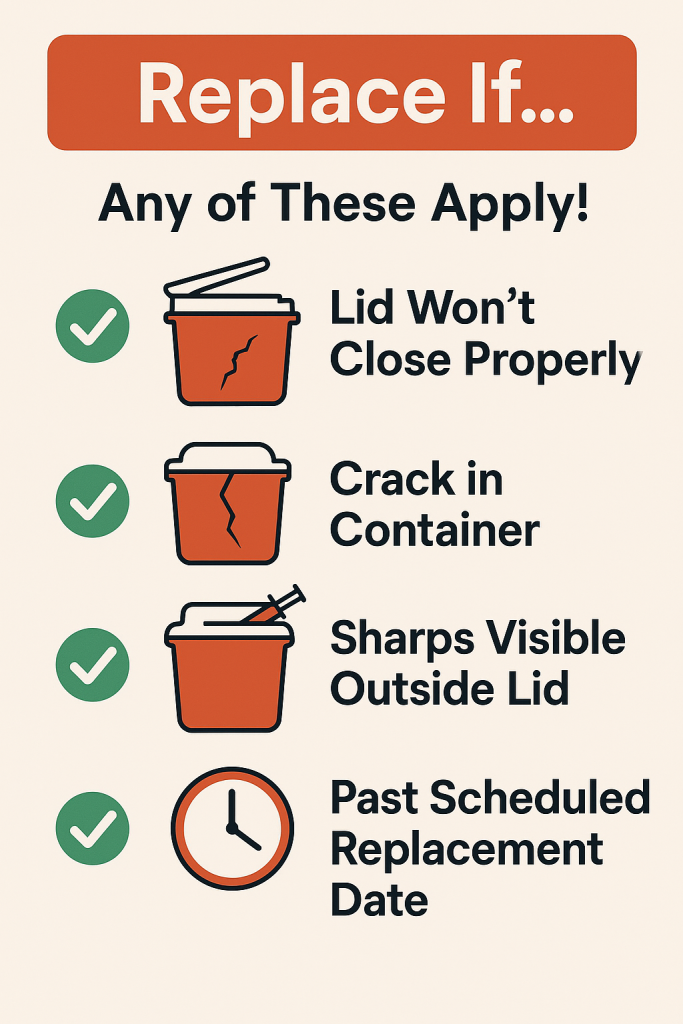
In some cases, a facility might replace a container sooner simply because it is easier to schedule waste pickups on a set rotation. For example, a clinic might change containers every week regardless of how full they are. This approach can help avoid last-minute replacements and reduce the risk of containers being left in service too long.
Best practices for replacement
Once a sharps container is ready to be replaced, it should be sealed securely before being removed from the work area. The sealed container must then be placed in an approved medical waste storage area until it is collected by a licensed disposal service.
Staff should never attempt to empty a sharps container for reuse, as this is both unsafe and illegal in most places.
Labeling containers with the date they were put into use can also help track replacement schedules. This is especially useful in lower-volume areas where containers may take longer to fill.
Even if a container has not reached the three-quarter mark, it’s common for facilities to have a policy to replace them after a certain amount of time has passed to avoid long-term storage of sharps in one place.
Why replacing on time matters
The risks of not replacing a sharps container on time are significant and can impact anyone who comes into contact with the container. This includes staff, patients, and waste handlers.
Needlestick injuries can expose staff to serious infections such as hepatitis B, hepatitis C, and HIV. If a person does get a needlestick injury, it can require a long process of testing and treatment to ensure that no lasting damage is done.
Beyond the health risks, there are also compliance issues. Medical waste disposal is regulated, and failure to manage sharps containers properly can result in fines or other penalties.
By replacing containers before they become a hazard, facilities protect both people and their compliance status. It also promotes a culture of safety, where staff know their well-being is a priority.
In summary
A sharps container should typically be replaced when it is three-quarters full, but earlier replacement is often the safest choice. Importantly, any containers that have been damaged should be immediately taken out of service to prevent harm to anyone.
Sharps disposal might seem like a small part of healthcare operations, but it has a big impact on safety. Staying on top of container replacement is one of the simplest and most effective ways to reduce risk in any environment where sharps are used.